
As I do my archivist work I skim through all of our past bulletins to see if there is anything interesting that could be used in the present day. The article below, written by “Jimbob” in Summer 1991, is, I think, one such article. Written before the internet and certainly well before smart phones, it’s a very thoughtful explanation of why we love lightweight camping.
Reading it some 35 years later the key messages that I picked up are:
These days, much more than in 1991, we are constantly bombarded with information and “messaging” of all types. Proper face to face social interaction is sadly in decline.
Now we carry our smart phones everywhere, but when we are camping, either by ourselves or in groups, we tend to use them a lot less. We are more occupied by our camping tasks, the nature around us and having conversations with the people around us. Using small tents “forces” us to spend more time outdoors and talking to other people because it’s not much fun sitting for hours in a small tent by yourself!
I always appreciate the diversity of people that I meet when I am on a camping trip, especially at an ALC meet!
We don’t care how you arrive or what you camp in, it’s not at all important because we are just enjoying our common love for being outdoors, and living in a small (tent) and simple way!
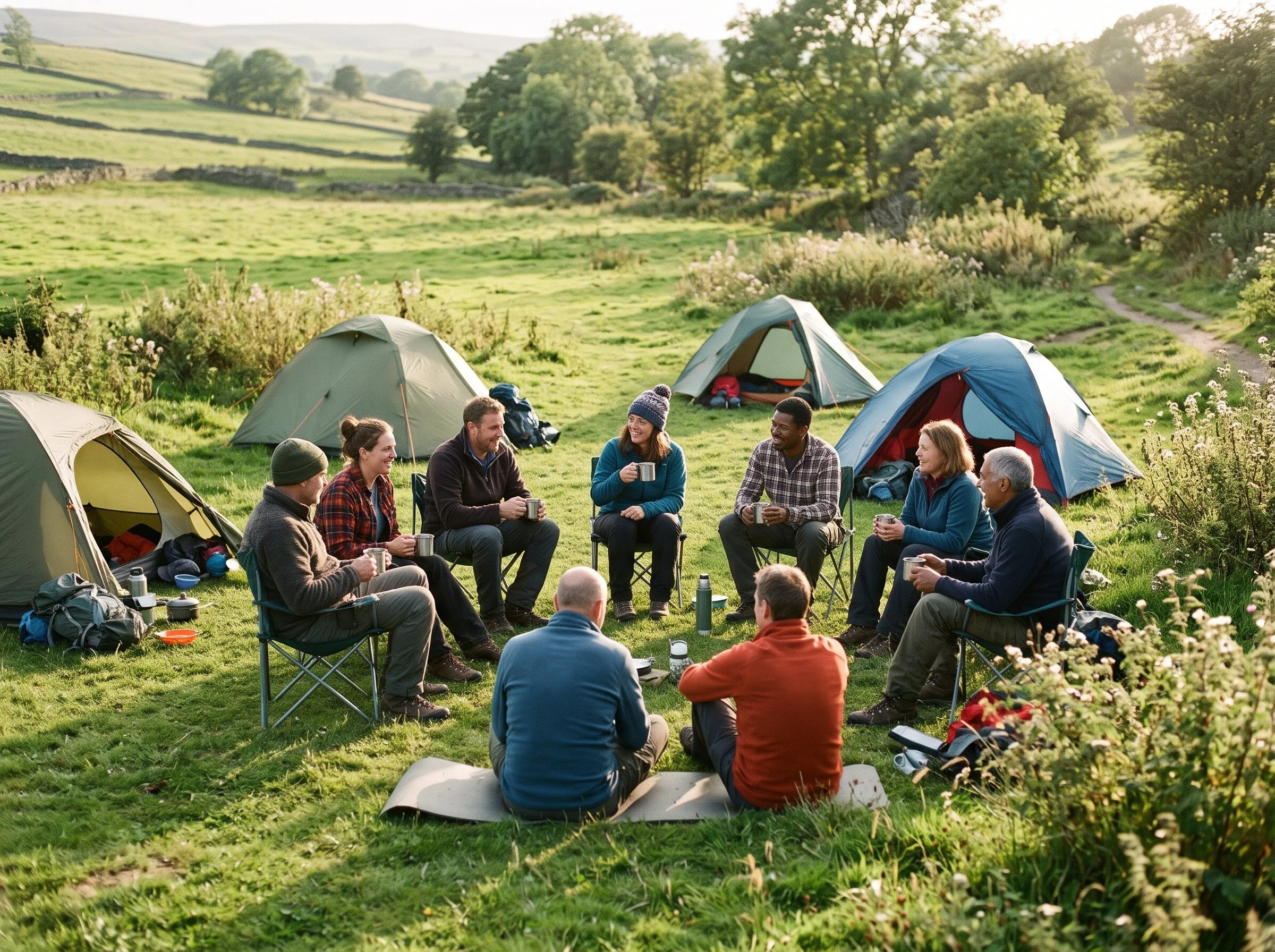
You can’t beat a good chat with no devices in sight!
“I'm often asked by friends and neighbours (who privately think I'm MAD) why I go lightweight camping. It's difficult to explain, the freedom, the friendships, the fresh air, etc, etc, I could go on, but I'm preaching to the converted. However, I was reading the Observer Magazine a while back and I came across an article by Dr John Collee headed SENSORY OVERLOAD. I quote quite freely by kind permission of 'The Observer'.
"I believe there's a condition, common in hyperactive children, called Attention Deficit Disorder. Some children exposed to too many stimuli lose the ability to concentrate on things that really matter. It strikes me that many adults suffer from a similar dis-order. What with the amount of TV, news, and casual interaction in London, it comes as no surprise.
"I don't know anything about social evolution but it strikes me that we were designed to live in small social groups, not herds of a million or more. We were also meant to communicate in person, on a one-to-one basis.....
"Most urbanites will tell you that If you leave the big city you'll find yourself starved of stimulating company. What they really mean by stimulating company is people of the same age, race, class, and profession. In a city you tend to form these artificial cliques, but in a small community you get to know a true cross section of the population.
"I recently spent some time in the Orkney Islands. During my stay I got to know a crofter, a church minister, a truck mechanic, a councillor and a theoretical physicist; these people all knew each other. They often exchanged ideas and their company was more stimulating, I guarantee, than anyone you will meet at the Groucho Club...
"I'm not speaking here as a doctor but as an inveterate, incurable grasper. And after years of futile grasping I know this for certain: you will always fall short. There will always be people who seem to be doing something more interesting and seem better at it. YOU will never look as good as the people in the commercials. YOU will never have read enough or had enough fun. It's obvious that hankering after what you can't have is fundamentally damaging BUT a lot of us are seriously addicted to it.
"It's taken me 20 years to discover that the best way to avoid this is to THROW THE WHOLE BULK PACKAGE AWAY. Don't do that stuff any more. Go somewhere where you can't get hold of it, where they don't have a radio, a TV, a telephone or even a bathroom mirror to contemplate. SOME PEOPLE CALL IT RUNNING AWAY, BUT I'VE COME TO REGARD IT AS A BASIC AND HEALTHY REFLEX. You find what's hurting you - FANTASY OVERLOAD and you move away from the source of the pain.
"Living in the sticks you find, magically, that you stop thinking about how things MIGHT BE and you start concentrating on the important things..... You get to know the people around you. You rely on them and they on you, instead of everyone striving individually towards some private nirvana.
"This is proper social interaction. You can focus on what you DO rather than constantly being distracted by coloured lights and flashes. ONCE YOU STAND FAR ENOUGH AWAY FROM IT, IT IS QUITE CLEAR THAT THE WHOLE MEDIA EDIFICE TERRY WOGAN, HOLLYWOOD AND THE OBSERVER is a lot less substantial than" a tent in the middle of a field.
The last eight words are mine. Stop the world I want to get off is what I tend to say. Perhaps there is more, psychologically speaking, in lightweight camping than meets the eye. Possibly, perhaps maybe, it's not ME that's mad after all.”
JIMBOB