
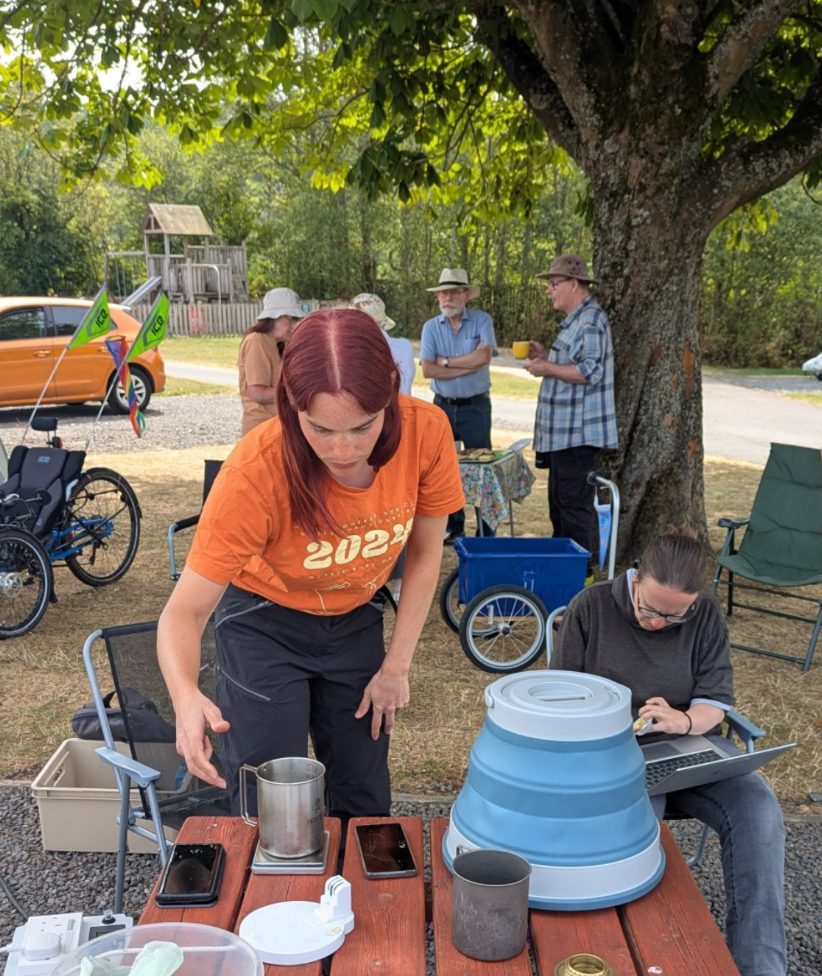
Kim checking weights while Natalya fires up the laptop to record the results!
By Kim and Natalya
The 2026 Tiny Tent Festival saw the return of the ALC stove competition, with a twist. The advent of the Jetboil had made the traditional competition to see who could boil water fastest rather boring, as there's very little that can compete with its highly-optimised design. At last year's Birthday Meet, Natalya suggested that a fuel efficiency competition might be interesting, so we decided to give that a try.
To that end, I spent some quality time researching the specific energy (that is, the amount of energy per unit mass) of various fuels, and crafting a spreadsheet to determine energy efficiency and power given the weights of fuel and water used. After a couple of test runs with my Trangia, I obtained a set of precision scales that could reasonably weigh differences of a few grams in the mass of a fuel container. Some people had expressed interest in how electric kettles and induction hobs would compare, so with the aid of an electrical energy meter, we were able to include a few of those, too.
(Note on units: As a child of the 80s, I've used unapologetically metric units and rounded for clarity. I've used Watt-hours rather than Joules for energy, as I expect that kilowatt-hours (energy) and Watts (power) are the units that people are most likely to have an intuitive sense of. Conversion to pints, BTUs, and horsepower are left as an exercise for the reader.)
How the Calculations Work: Worked Examples
For the benefit of those without a science or engineering background—and hopefully without getting too deep in the weeds of chemistry or electrical engineering—here is how the calculations work:
1. Electric Kettle
The energy meter showed that Susan's electric kettle consumed 80 Watt-hours of electricity (0.08 kilowatt-hours, or about the same amount of energy as you'd get from a good power tool battery) to boil 678.3g of water (a bit more than half a litre, to ensure the heating element was fully submerged).
Energy Efficiency: Dividing the amount of energy by the amount of water gives 118 Wh/litre.
Power: It took 4:42.23 to boil, so dividing 80 Wh by 282.43 seconds gives a power (the rate of use of energy) of 1,020 Watts—pretty much spot on for a 1kW-rated camping kettle.
2. Gas Trangia
My Trangia 27, with a Go Systems gas burner running on a standard threaded butane/propane cartridge, heated 507.9g of ambient-temperature water to a rolling boil. The cartridge weighed 387.2g at the start and 378.5g afterwards, meaning 8.7g of fuel was consumed. Assuming a 50:50 mixture of butane (13.6 Wh/g) and propane (13.9 Wh/g), the stove consumed 4.35g of each.
Energy Efficiency: Dividing the total energy consumed by the amount of water gives 236 Wh per litre of water boiled.
Power: It took 4:21.41 (slightly quicker than the electric kettle), which gives a power of 1,647 Watts.
Takeaway: The gas Trangia produces more power than the electric kettle, but uses almost twice as much energy to heat a litre of water; much more of the energy consumed is wasted, mostly in the form of hot gases escaping to the environment.
What About Fuel Weight?
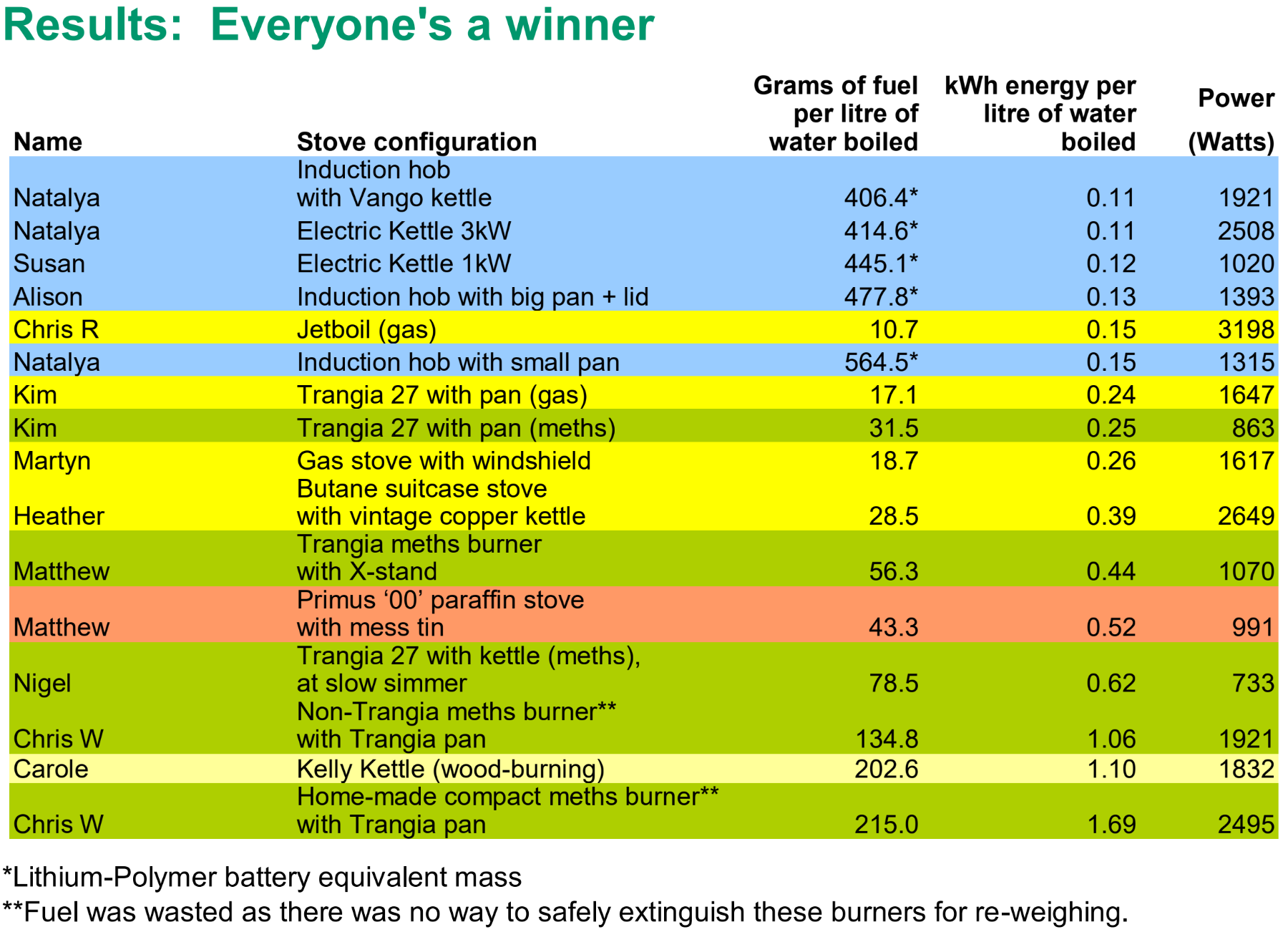
As lightweight campers, we might also be interested in the weight of the fuel we have to carry. The Trangia would need about 17g of gas to boil a whole litre of water. While we can't weigh electrons consumed by a kettle, if you powered Susan's kettle from a state-of-the-art Lithium-Polymer rechargeable battery (which achieves about 265 Wh/kg), you'd need about 445g of LiPo batteries to boil a litre of water. Combustion fuels are considerably more energy-dense than batteries.
Key Findings from the Leaderboard
Electric & Jetboil Lead the Pack: Electric stoves are extremely energy efficient—no surprises there. Impressively, the Jetboil is also right up there, holding its own against induction hobs with pans: speedy and efficient.
Enclosed Systems & Simmering: We then see a cluster of efficiency-oriented fuel-burning stoves. The Trangia achieves very similar efficiency figures running on both gas and meths, though the gas burner has almost double the power output (and consequently almost half the boiling time). Nigel's idea of using the Trangia burner in simmer mode turns out not to be a winning strategy—this was the slowest of all our entries, taking over 22 minutes to achieve a lacklustre boil.
Wind & Pan Size Matter: Lightweight open stove designs are less efficient than enclosed designs, and the wide spread of efficiency figures for these was partially due to the wind. Most would benefit from a windshield. Matthew's Primus stove was also hampered by a slow start and trying to boil water in an oversized mess tin.
Wood-Burning & Unextinguishable Burners: At the bottom of the table are Chris's meths burners (which scored artificially badly because unused fuel couldn't be extinguished and weighed) and Carole's Kelly Kettle. Because specific energy figures for wood are based on uniform logs or pellets rather than random twigs and leaves, those numbers should be taken with a generous pinch of salt. Ultimately, efficiency is much less important when you can collect fuel from the environment!
Further Discussion: Real-World Lightweight Camping
Obviously, none of this was done in laboratory conditions. We were limited by the precision of the scales and meter, inconsistent wind, minor spillages, and the difficulty of judging a "rolling boil" on lower-power stoves that never moved past the "small bubbles" stage. Next time, we could use a thermometer and control the starting water temperature, or test the same stove with different containers and windshields.
Beyond pure boiling efficiency, campers have to weigh several practical factors:
Equipment & Fuel Weight
We didn't factor in the mass of the stove itself or its fuel containers. Liquid fuels allow you to top up a container before a trip, whereas gas cartridges often require carrying a spare to avoid running out. Mains electricity requires an unwieldy hook-up cable and heavy appliances. While we're a long way from battery-powered lightweight stoves (we'd need an order of magnitude increase in energy density), a vehicle-portable 1kWh battery pack with solar panels—or an electric vehicle with AC output—can easily handle campsite cooking.
Cost, Safety & Environmental Impact
Electricity: Cheap, safe to use inside tents, and increasingly green.
Wood: Free and carbon-neutral in small quantities, though reliability varies and smoke can bother neighbours.
Gas Cartridges: Fossil-fuel based, relatively expensive, and come with disposal issues.
Liquid Fuels: Fiddly and require a thorough understanding to operate safely, though easy to decant for long trips.
Versatility & Stability
Jetboils, electric kettles, and Kelly Kettles excel at boiling water, but are suboptimal for general cooking. Larger, more stable stoves reduce the risk of tipping dinner onto the ground during overenthusiastic stirring—though smooth induction hobs can cause pans to vibrate and migrate toward the edge if not perfectly level. (Editor's tip: A Silicone Induction Hob Protector Mat will help prevent pan migration!)
Ultimately, cycle-campers and backpackers will often choose to trade a bit of efficiency and convenience for a lighter, more compact stove, as the weight of the stove equipment usually dominates that of the fuel.
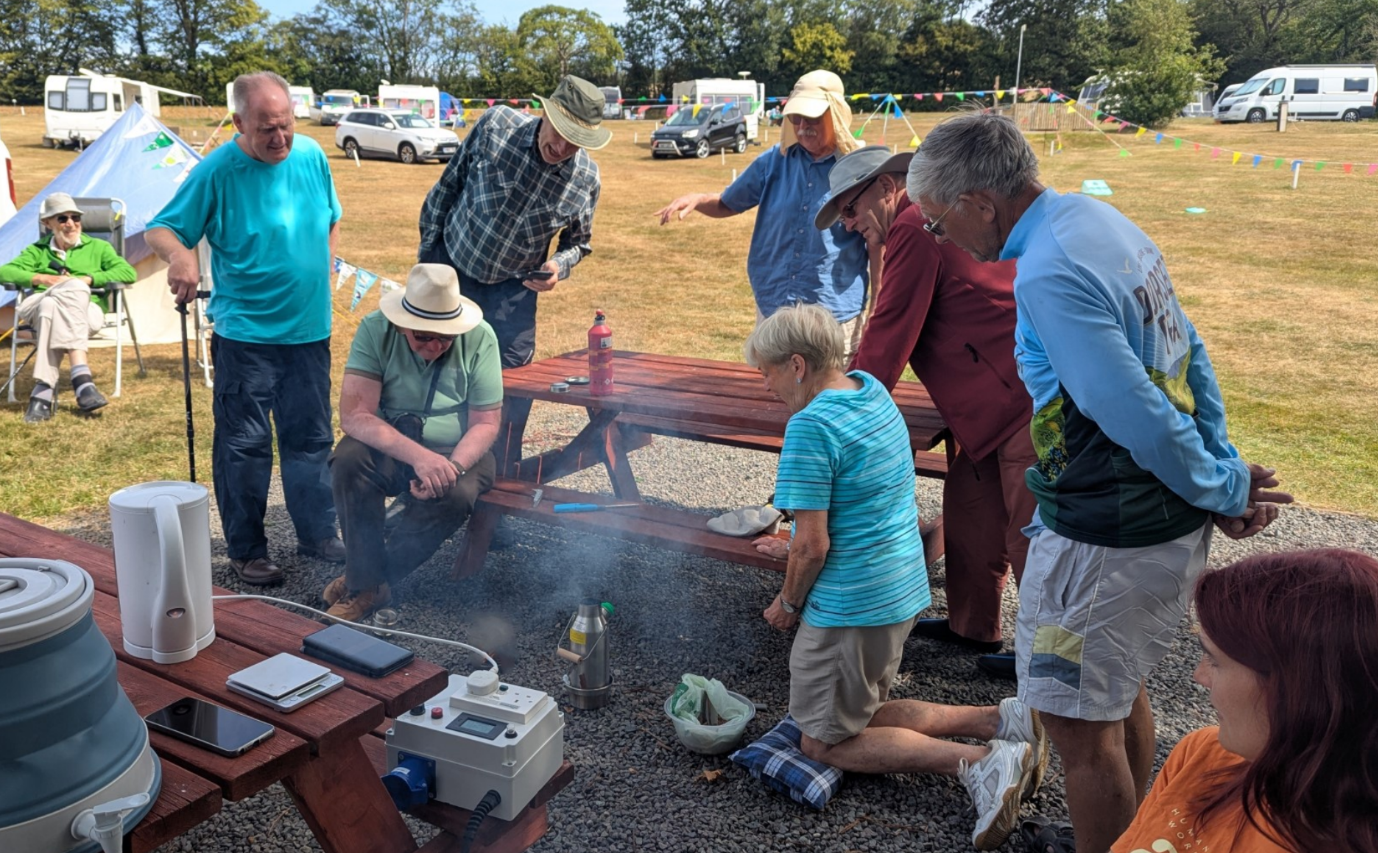
The Kelly Kettle belongs to Chris R and had never been used, so Carole was experimenting, but got there in the end and everyone enjoyed the journey!