
The following article was written by one of our former members, Margery Price, in June 1964. It was written in a bygone age but, of course, this beautiful place still exists! The railway line that she refers to did, in fact, close but is now an accessible path from Mossdale, which is about 15km North West of Castle Douglas.
There are so many beautiful places to visit with your tent in the British Isles, before venturing abroad, and the area is certainly on my “To Do List”! If you are interested in wild camping near Loch Skerrow, on foot or by bicycle, here is a brief description of the route from Mossdale (it’s much more accessible than in Margery’s day):
The path follows a remote section of the former Portpatrick Railway, often referred to as the "Paddy Line". This route offers a tranquil, traffic-free experience through the wild moorlands of Galloway Forest Park.
Route Details
Distance: Approximately 4 miles (6.4 km) one way.
Terrain: The path primarily consists of the old railway trackbed, which is relatively level. The surface is a mix of granite clinker, grassy tracks, and sections of forest road.
Suitability: If cycling it’s best for gravel bikes or mountain bikes. While mostly flat, some sections can be boggy or rough, and there is a short, steep climb to regain the rail bed near the viaduct.
Key Landmarks:
Loch Skerrow Halt: The ruins of a remote railway station and its intact platforms.
Stroan Viaduct: A four-arch span crossing the Black Water of Dee near Loch Stroan.
The Raiders' Road: The route intersects with this well-known 10-mile forest drive near Mossdale, providing options for longer loops.
Practical Information
Access: If driving you can park at the old Mossdale Station to begin your route.
Facilities: This is a highly remote area with no shops or services between the two points. The nearest refreshments are at The Gallery at Laurieston or in New Galloway.
Navigation: While the old railway line acts as a clear guide, some sections may require you to briefly divert onto signposted forestry tracks.
One last tip would be to avoid the midge season (late May to early September)!
Now let’s see if Margery can whet your appetite:
THE CAMP THAT NEVER WAS by Margery Price
Or so it seems now. Certainly it never will be again, for the curious little railway halt of Loch Skerrow in the middle of an untracked, nameless Galloway moor is now closed to public access, and the scenic rail route itself is threatened under the Beeching Plan. Of course, roughstuff enthusiasts could hump kit and bike over the almost obliterated track by Grobdale from the Laurieston road, or (let me whisper it) ride along the line from Gatehouse of Fleet station on a Sunday when no trains run. But Loch Skerrow itself has been taken over by the Forestry people, to be surrounded by regimented conifers planted in great hacked-up furrows, as over so much of the hill-country of Galloway, that beautiful neglected land on the other side of the Solway.
When I first saw Loch Skerrow, it was from the Ulster Express and I was bound for the Emerald Isle. I had chosen the Stranraer route because I had never known anyone who had explored the South-West of Scotland, despite the sizable and extensive hill masses indicated on the map. What I saw almost put Ulster out of my head, for beyond Castle Douglas, one of the many delightful little white-painted towns of Galloway, the train plunged across a wild moor which in retrospect resembled the more famous Moor of Rannoch in miniature. Indeed, this was a small-scale Highland landscape. There on the horizon were the blue peaks, and a wild river, brown with creaming foam, rushed at their feet. One white croft stood in the middle of it all, perhaps inhabited, though others were shown on the map as ruins, with beautiful Gaelic names like Orchar and Drummore.
A little farther on the train drew up at the smallest railway station I have ever seen. Its platform was a yard or two wide and a few yards long. Beside it a loch with an island in it gleamed in the brown bogland, and a green slope with a rocky crest rose beyond. A board announcing TEAS was affixed optimistically to one of the small row of cottages beside the station, which appeared to have no approach by road. I learned later that the TEAS were for the benefit of the fishermen who sometimes tried their luck in Loch Skerrow.
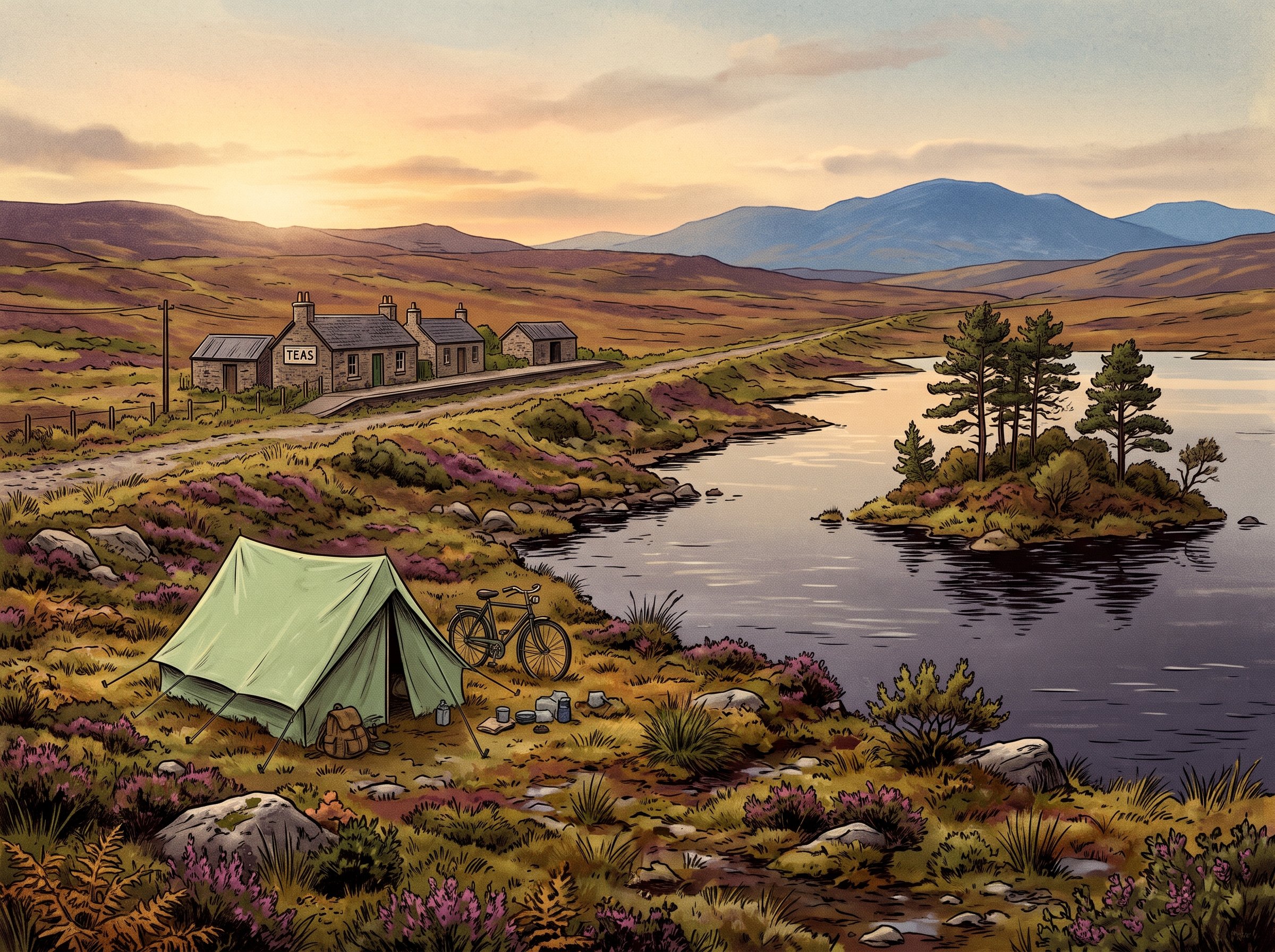
I returned from that holiday with thoughts of a camp at Loch Skerrow floating vaguely through my head. Not a cycle-camp, certainly, but the idea was to take my kit on the train, drop off at the tiny station, and spend a couple of days—a Bank Holiday weekend most likely—virtually in retreat from the world. An August Bank Holiday a few years later saw that dream come true. Galloway was for once wreathed in smiles; so often she weeps with Celtic dolour. Cairnsmore of Fleet to the West was half-hidden in heat-haze, and the midges rose in clouds by the side of Loch Skerrow as I pitched the Guinea Minor, helped by the Stationmaster's elder boy, who kindly hacked away the long heather for me.
The midges settled at last and so did I, hoping that no wind arose, because my tent-pegs had only a very insecure hold in the spongy soil. Next day, signifying my intention of going to Loch Grennoch, a largish loch to the west, I was despatched down the line (it was Sunday) on the Stationmaster's wife's bike to pick up one of the new forestry tracks to within a mile or so of Loch Grennoch. I was just a little put out at this as the main point of my camp at Loch Skerrow was to avoid all man-made ways for a day or two, but I knew the offer was well-meant, and it is difficult to refuse hospitality, particularly Scottish hospitality.
As it happened, a mile or so's tramp from the forestry track over the hills below Loch Fleet and down to Loch Grennoch soon changed my views. I have tramped over the Pennines' worst, on Cheviot, and over similar roughstuff in many parts of Wales and Highland Scotland, but for sheer impossibly tough going underfoot I do not think anything can quite touch the vegetation of the moors backing the west coast of Scotland, and Galloway is part of that West Coast, far more akin in scenery and vegetation, place-names and people, to the North-West Highlands than to the Border Country she adjoins. Boggy subsoil, big spears of grass shooting up from a springy mat, bog myrtle, hidden rocks, purple flowers, waist-high bracken and almost anything else in that line you can think of. You get the same sort of stuff in Sutherland, below Suilven and Quinag, in a terrain which, like Galloway, sometimes seems to have more water than land.
When I reached the silver sand of Loch Grennoch, pure Highland with its shooting-lodge, Scots pines and rhododendrons, my first thought was to strip off clothes and get into the water. Two anglers on the opposite shore were the only company at first (fortunately I had brought a swim-suit) but later a Scottish family party arrived. The anglers were much concerned that the grandmother had walked the mile of rough track from the forestry road to the loch. Their own wives had been left in the car on the road. They were from Southport!!
Once again I watched the sun sink behind Cairnsmore's 2200 foot bulk and, in the morning, the blue shadows move over the glassy surface of the loch. The weather was on the change however, and in any case I had to return on the midday train (the later one just missing the connection at Dumfries in the way the timetable-makers seem to delight in.) I said goodbye to the hospitable station family—the man who came from Cumberland and hated the place but could not leave because no-one would replace him; his wife, a Scot, contented with her home; the elder boy, who took things as they came; and the younger son, an inarticulate red-faced young Scot who, his father said, adored Loch Skerrow, and had made himself a small tent in imitation of mine.
Like so many dreams, this one did not quite come true. In the few years that had passed since my first-love sight of the Fleet moorlands, the inaccessibility had gone in one sense, yet man had made Loch Skerrow even more inaccessible. But I count those two days and nights in the hidden heart of a Galloway moor as one of my never-to-be-forgotten experiences in an increasingly stereotyped world, where only the young and male may venture into the wild places alone and unorganised.