
By Jim Pickett. (Hon. Tech. Officer)
(This is taken from a 1980’s issue of our bulletin and is for historical interest only, NO advice or suggestions should be relied on!)
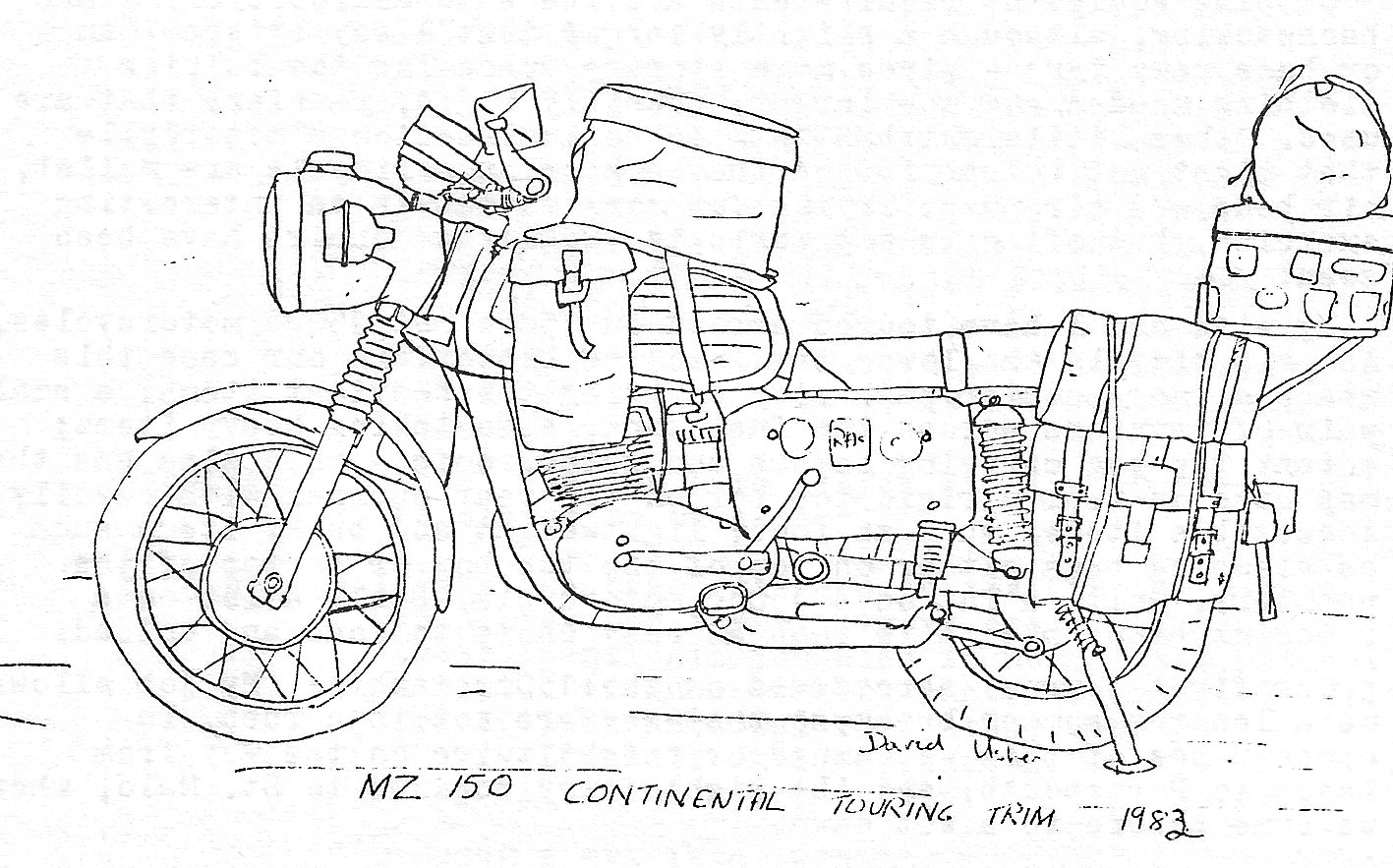
Coincidentally I owned one of these motorbikes in the early 1980s but sadly never went camping on it!
For the lightweighter, the differences between motor cycle camping and other forms are few. Although the restrictions are different, they produce a very similar sort of kit and a very similar style of camping to that of the cyclist or the walker.
The principal difference is that for all practical purposes weight becomes unimportant. Even with a pillion passenger, 25kg of kit is no problem. Without a passenger, the sky's the limit. My own machine allows up to 180kg of luggage, although how I would stow it without destroying all pretensions to roadworthiness is a mystery. Usually, bulk is the deciding factor.
Thus, an air bed becomes a perfectly reasonable piece of equipment; because although it weighs many times more (typically 2-3kg) than say a Karrimat, it is no bulkier. On the other hand, although a synthetic sleeping bag is to be recommended, (motorcyclists' kit can get very wet) most people use down because of the bulk of synthetics.
Of course there are other differences. For example, on a longish holiday few motor cyclists can resist the idea that the bike fuel tank contains an unlimited supply of fuel for the stove. It works, too, if you are very careful!!
Perhaps surprisingly, one of the motor cyclist's biggest problems is storage space in camp. Riding gear can be space-consuming, and so can luggage. Which would be alright, except that neither of them is very nice to have in your bed-space when sopping wet. So you need to choose your tent with under-flysheet storage space in mind.
On the subject of tents, if a motor-cycle camper intends to travel fast and far, he or she should remember that a day's journey of 400 or 500 miles can take the camper into weather conditions vastly different from those at the start of the trip. A really weather-resistant tent is virtually essential.
For most people, the biggest problem is getting the kit on the bike. Where to put it and how to pack it? Unless you are prepared to spend a great deal of money, motor cycle luggage is uniformly awful. Soft luggage is made from thick black PVC-coated canvas. It tears, it lets in the rain and it usually has cheap and nasty fasteners and zips. Examine the products of as many manufacturers as you can find. Look at the largest bags that will fit onto your machine, because the larger they are, the less strain on the material when full. Look especially for good quality fasteners, plus straps and buckles which can be pulled tight (like those on a rucksack or a bicycle pannier).
For one person, a pair of throw-over panniers (just like John Wayne's) and a big tank bag should be enough, but you will almost certainly have to find something else for your tent poles because they are usually too long to fit into any motorcycle luggage. If you don't want to make your own, try a fishing rod case from your friendly local angling shop. Fix it across the back of the seat with (bungee) shock cords.
Once upon a time, all motorcycle campers used dustbin liners to keep the rain out of their luggage. Forget it. Today's dustbin liners are so thin that they are not even any good as dustbin liners. Instead, get a set of 500 gauge plastic bags (survival bags cut down are good, but opaque). They will last for years, given careful treatment, and won't split en route.
Spread the load evenly among the bags (the tank bag should be heavy) and put the throw-overs as far forward on the seat as you can without impairing control. If they make the seat uncomfortable, try putting the web between the bags under the seat. If you intend to use rigid pannier boxes, fit them as far forward as possible, and if they are well laden try to balance them up with a tank bag or a pair of tank panniers. The best manufacturers (e.g. Krauser) give you a maximum load specification with the boxes. Of course, if you have a full fairing, it will go a long way towards balancing the pannier boxes and will give you a most useful additional storage capacity behind the leg shields.
The essential point is to keep the weight between the axles, with the centre of gravity as near to the original as possible.
Under no circumstances put heavy gear in a top-box. The effect of a laden top-box at speed can be fatal.