
A 1953 Cape Town to Rhodesia (now Zimbabwe) Journey - Originally written by Alan J. Beasley, an ALC member of those times
Forward by Nigel:
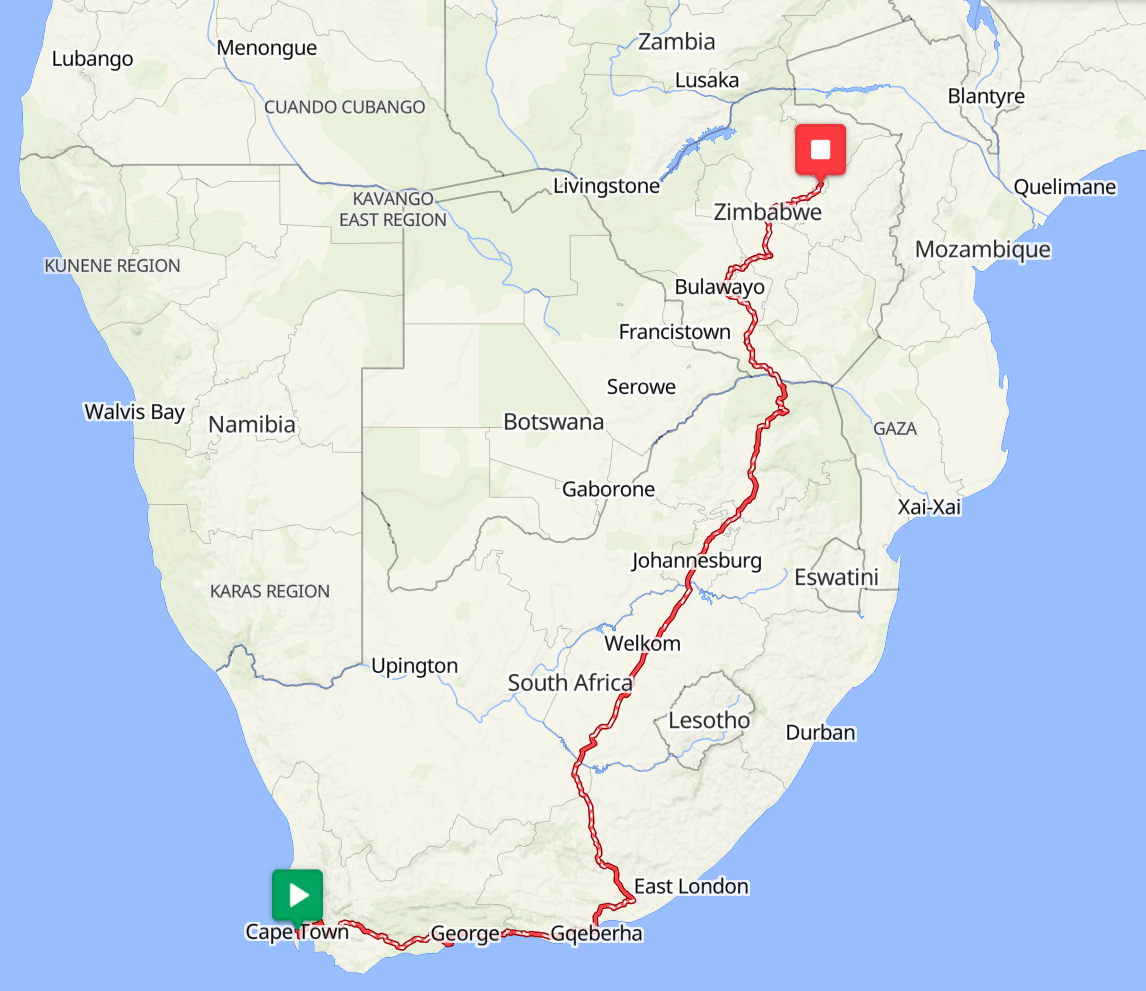
This incredible 3800km journey was undertaken on a slightly modified (see end) Rayleigh Sports bicycle with a lowest gear of 39 gear inches - these days about 20 gear inches is considered normal for a bicycle tourer! This is especially impressive when you know that he probably climbed about 30,000 metres over the total route, more than three times the height of Mount Everest! I roughly mapped out the route on Ride With GPS, I can send it to you if you fancy an African adventure…
We know from public records that Mr. Beasley left London 19 March 1953, then 25 years old, on a ship called “Warwick Castle”, which had its own interesting history.
—------------------------
I arrived at Cape Town at Easter last year (1953), bound for Northern Rhodesia. I had brought my bike and camping gear with the intention of doing some exploring in the Cape Peninsular, but with a completely open mind as to whether I would attempt to cycle any of the route to my destination. That was to be dependent upon how I found road and climatic conditions near Cape Town, and any information I could pick up from local people who had travelled over any of the route.
After the usual Customs and Immigration formalities, I rode out to a camping site 12 miles from Cape Town, by a lake called Princess Vlei, which is the local name for a lake. It is a beautiful sandy site amidst trees, and the view across the lake with Table Mountain reflected in the water on a calm day I shall remember for a long time. The site being sandy was very lucky as it rained a lot while I was there, usually at night and during the morning, and the rain was able to soak away. But the sand wasn't so good when a gale sprang up, and very soon I had all the guys tied to trees, or weighed down by large stones. In spite of the poor weather I managed to do quite a lot of cycling in the Cape Peninsular, including one trip out to the Cape of Good Hope, a very bleak spot at that time of the year, as it was autumn there. The adjacent part of the peninsula is a nature reserve where many of the large number of local wild flowers can be seen, and also an occasional buck.
During all the time I spent there, I was waiting for a day fine enough to permit the ascent of Table Mountain, as there would be no point in getting to the top only to find it veiled in cloud, apart from the risk of walking over a cliff. Eventually a day did dawn fine and cloudless, so I armed myself with several pounds of grapes, at 3d.(about 6p) per pound, for refreshment and set off, on foot of course, up via a gorge known as Skeleton Gorge. It is a 3,500 ft. climb, but well worth it when the top is reached. Inland one sees the Hottentot Holland range of mountains, capped with snow at that time. To one side are the Twelve Apostles mountains running along the peninsula parallel to the sea. On the other hand one sees for miles along a flat coast to Saldanha Bay. And then there is the sea in front. The Russian whaling fleet was just leaving Cape Town for the north, and the factory ship with its little fleet of attendant smaller whalers made a memorable sight as they sailed into the sun.
During the ten days at Cape Town I had managed to find out that there was a tarred road most of the way to Port Elizabeth (now Gqeberha), so I decided to cycle that stretch at least, having found cycling there not particularly arduous so far. It happened to be about the best time of the year for cycling - not too hot, and no rain worth mentioning after leaving the vicinity of the Cape. From Cape Town I cycled along a fine tarred road to Paarl, the centre of the wine area, and camped on a farm on the banks of the Great Berg River. I awoke next morning to find it raining, but it looked as though it might clear up later, so I waited hopefully. However, it didn't, so I resigned myself to packing a wet tent, and pressed on through the Fransch Hoek valley to the town of that name, where there is a fine monument to the Huguenot settlers.
All roads from Cape Town to the east and north go over passes, and this one was no exception. It was grim, with the wind whistling amongst the rocky crags overhead and trying to blow me over, and curtains of rain and mist drifting across the valley in waves. No doubt there are very fine views from the pass, but I didn't see any of them. I arrived at the top soaked in sweat, and then started to dry out, and freeze in the process, whilst descending the other side. It was raining too hard to permit me to put on a sweater, so I just had to let my teeth chatter, free-wheeling slowly because of all the stone-littered hairpin bends. Eventually I reached the bottom and was able to don more clothes in the shelter of some trees. The pass itself was untarred and stony, but beyond that I found myself back on a good road again for a few miles. But not for long! Soon I had my first taste of a South African country road with deep banks of gravel and dust at the sides, and corrugations in the middle and loose stones everywhere. By now the rain had stopped but the wind was still blowing half a gale, so as soon as I saw a good clump of trees to provide shelter I pitched camp. There was a small stream conveniently close, a bit muddy after the heavy rains, but it soon settled in the bucket, and with a couple of pints of tea and a good feed inside I soon had my head down for the night.
The next morning I was awakened by a frightful clamour, and on sticking my head out I discovered I had pitched in the shelter of a tree occupied by a large colony of weaver birds. These build completely enclosed nests, (except for an entrance hole), hanging from the end of branches and always build in colonies, sometimes dozens in the same tree. They are usually noisy, but the unwanted presence of the tent beneath incited them to even louder efforts. It was obvious there would be no more sleep for me that morning so I had an early start, and before long got back on to the National Road to Port Elizabeth, which is tarred for most of the way.
For the first 200 odd miles, until Mossel Bay is reached, the road is miles from the coast. It undulates up and down over hills, none too steep to ride, with usually a range of mountains inland on the left, and rolling farmland on the right. A town appears about every thirty miles, but otherwise for most of the way the only signs of habitation are the occasional dusty farm tracks disappearing into the veld on either side. The map shows the towns in very imposing print, but when one reaches most of them they turn out to be just another typical South African "dorp"; that is, just a garage, post office, church, a couple of stores, possibly a small hotel and a few houses. Most of the way along this "coast" road I had a tail wind which was a great help.
Towards evening on the first day the wind started to strengthen again, so I stopped to camp as soon as I came to a suitably sheltered spot amongst some thorn trees near a dry river bed. As far as distance travelled is concerned this was one of my best days, as I did just over 97 miles. Apart from stops at towns to get provisions, and a lunch break, I found nothing to detain me anywhere, and could just plod along all day. The next day I didn't do too well. It rained during the afternoon and just as I reached Riversdale more rain was threatening. Outside the town I saw a sign, "Tourist Camp", so decided to call it a day, although it was still quite early. The camp superintendent was Afrikaans speaking and knew hardly any English, but he was very friendly and managed to convey to me where to find water, showerbath, etc. I got the tent up in the shelter of some gum trees just before the rain descended in bucketfuls, and then had a shower just outside the tent, it being quite unnecessary to go to the shower house for it. It rained all the evening and most of the night, and brought out all the frogs in the neighbourhood - I had to eject several from the tent during the evening!
This turned out to be the last real rain which I was to see during the trip. Beyond Riversdale the road levelled out a bit, and the mountains on the left gradually receded. I reached Mossel Bay in due course, and saw the sea again. The town is at the foot of a steep hill, which I would have had to climb again to get back onto my course, so as it was Sunday and nothing would have been open I decided to give the place a miss. Beyond the Great Brak River there was a long hill which I was just able to pedal up. I learned the next day that it had been open only a week, the road having previously been deviated for miles around on a rough track, so I was very thankful not to have arrived a week earlier. Not much further on I noticed a sheltered spot with beautiful turf (a rare sight there), and the sight of mushrooms growing in a meadow nearby was enough to make me halt for the night. It was very cold during the night, sufficient to make a sweater necessary, and the next morning the tent was drenched with dew. I waited for it to dry, as the sun was rising into a cloudless sky, but it was nearly ten o'clock before it finally dried out. There was not much future in that, so henceforth I put up with the added weight of a wet tent after heavy dew.
Soon I was in the oak shaded avenues of the town of George, described by Trollope as the "prettiest village in the world, at least the prettiest I have ever seen". I went into a cycle shop (another rare sight!) to get some oil, and soon found myself engaged in a long chat with the proprietor, cycle-tourists being uncommon in those parts, to say the least of it. When I returned to the bike I found quite a gathering there, and expected the press to arrive at any moment. However, I got off with only my photograph being taken by a girl from a nearby photographers.
Leaving George I passed a very attractive looking camp site and was tempted to stay. But it was still very early, in spite of my late start in the morning, so I pressed on past State forests of gums and pines. A few miles further on, down a rocky valley, I came to the sea again at the Wilderness. This is indeed a wilderness of sand dunes and small lagoons, and again I was tempted to camp, but compromised by having lunch on the shore, with enormous waves breaking on the beach in front. Some miles further I reached Knysna lagoon, littered with beautiful camp sites, and succumbed when I came upon a grassy tree-sheltered spot overlooking the lagoon. I had my first South African "bangers" for supper. Very fine! The next day I spent a lot of time around the lagoon and amongst the native forests of Stinkwood and similar trees, from which fine furniture is made locally.
Later I reached the Groot River Pass. This is a sort of pass upside down, as the road descends a gloomy forested gorge into the Groot River valley, and then climbs out again, or rather the cyclist pushes out again! Not far beyond I camped again. Setting off next morning I found myself almost immediately in a sunless forest on a dusty untarred road. A few miles further on I came upon a scene of great activity where bulldozers, scrapers, earth-movers and other noisy machines were working on the new National road, which crosses the old one at this point. After watching the operations for a few minutes, I plunged back into the silent forest, seemingly even more silent after the noisy scene behind. In this area there were about 30 miles of yet untarred road, and I found it necessary to stop every time a car passed, as they raised so much dust it was impossible to see.
Two more days brought me to Port Elizabeth, with nothing of special interest, except for the sight of several tortoises rashly crossing the road, and plantations of pineapples. About here I discovered that pineapples were cheaper than grapes, so I changed to them for refreshment on the road. At Port Elizabeth I camped at a tourist camp site by the sea not far out of the town. Until then I had not seen any other campers, as it was not the holiday season, but here there were several, some of whom seemed to be living there, and I was able to talk shop for a change. I spent a very leisurely two days there, doing some much needed laundry after the dust of the roads, and visited various places of interest, including the famous snakepark. Here they have specimens of all the snakes found in South Africa, enough to deter anyone from camping there. As a matter of fact, the only snakes I saw during the whole tour were dead ones on the road, squashed by the traffic.
By this time I had decided to cycle at least as far as Johannesburg, so on leaving Port Elizabeth I headed for the cathedral and university city of Grahamstown(now Makhanda), which I reached after one camp on the way. Again it was Sunday, but the museum was open, so I was able to visit that. Beyond Grahamstown the fine new tarred road suddenly turned into earth again after a few miles, and remained so for most of the 200 miles to Colesberg. Fortunately there was little traffic on the road, so I had a dust bath only about once an hour. This stretch took me three days. For some distance the road follows the Great Fish River valley, with many farms irrigated from the river. The sight of green meadows with weeping-willows hanging over the irrigation channels, and the farm buildings set amongst groups of gum trees, made a refreshing change from the usual veld, very dry and brown at that time of the year.
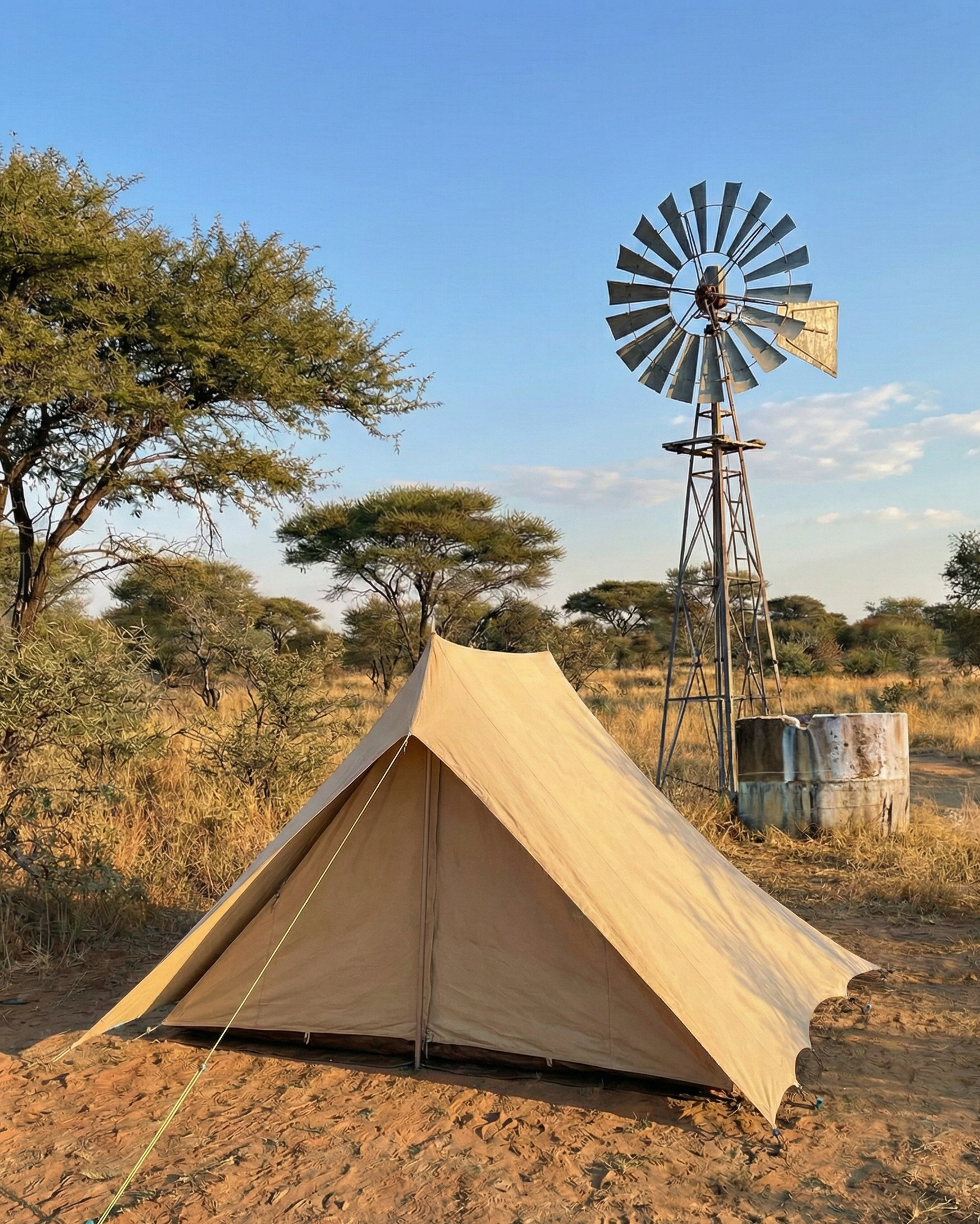
Beyond here the country changed, being very dry, the only water being obtained from underground by means of wind-pumps. The farms are few and far between, usually set well away from the road. The road just presses on through the bare veld, climbing slightly most of the time, but crossing a small range of hills occasionally, and all one sees to break the monotony are an odd herd of sheep, the occasional solitary wind-pump, and the dusty tracks leading away to the invisible farms miles from the road. But for these wind-pumps this would have been a thirsty stretch, as the rivers and streams were all quite dry. As it was I would start to look for a wind-pump as lunch-time or nightfall approached, and brew up tea in the first case, or camp nearby in the latter case. Camping was usually only a matter of climbing over a bit of barbed wire fence by the road, there being no-one to grant or refuse permission, and one piece of veld being no different from that a few miles further on. One sad evening wind-pumps seemed to be getting scarce, and then I sighted one some distance from the road just as it was getting dark. I pitched the tent and then trudged across the veld with my bucket, only to find the tank empty and the pump out of order. By then it was too dark to look further afield, so I had to content myself with the depleted contents of my water bottle. Next morning I found another pump on the other side of the road, so I was able to start the day with plenty of tea and full water bottles.
Just before Colesberg I regained the main National road to Johannesburg, and crossed the Orange River into the Free State a few miles beyond. The remaining 100 miles to Bloemfontein were uneventful, except for the sight of a pair of ostriches and a small herd of springbok. At Bloemfontein the Information Bureau directed me to a pleasure resort (Maselsport Resort) a few miles away at a dam, which included a campsite amongst its amenities. When I arrived there I found a very fine site under the usual gum trees, and not far away was a swimming pool, 444 feet long, claimed to be the longest in the southern hemisphere. Then there was the dam itself, (a reservoir for the city), with boats and a cafe. I had the place to myself most of the time, though a few people appeared on the Sunday. It was an ideal spot to spend a few idle days, but I was rather short of time because the Customs people at Cape Town had limited my stay to one month in order not to make my gear dutiable. Eventually I got this extended in Johannesburg, after wandering about the Customs Dept. offices there for about two hours, looking for somebody who knew anything about the subject.
When I struck camp from Bloemfontein I decided to take one of the country roads to the main road, to avoid going back into the city, but soon found myself in a network of farm roads and decided to camp on the spot and sort myself out the next day. I was attacked by mosquitoes as I was setting up the tent, so I hastily fetched a bucket of water from a nearby storage tank and retired into the tent to cook supper. On the whole I had no trouble from mosquitoes or other pests. They appeared only a few times just at dusk, so I had to be a bit nippy making camp sometimes. The next day I regained the main road, after a couple of punctures from thorns on the earth road, and settled down to do the 270 odd miles to Johannesburg. The first day a tailwind and a fairly level road enabled me to cover 101 miles, so I arrived in Johannesburg in something less than three days cycling. There I put away the camp kit for a week, having been invited to stay with a cycling acquaintance, so I enjoyed the luxury of cycling all over the place without the weight of kit behind. The highlight there was a trip down a gold mine, organised by the Chamber of Mines. Everything was provided: a luxury coach to take the party out to the mine 30 miles away; overalls, boots, and helmets for the underground tour; a shower afterwards; and a wonderful lunch at a posh country club at the end.
After a week in Johannesburg I decided that I had seen all that I wanted to see, so I set off for the north again. I passed Pretoria less than 40 miles on, but wasn't a bit impressed by this city which is the administrative capital of the Union. However, the Union Buildings and the Voortrekker memorial, which are both set upon hills outside the city, are very fine. North of Pretoria the towns get even further apart, until between Pietersburg (now Polokwane) and Louis Trichardt is a stretch of 69 miles. It seems that there is still a lot of game in those parts, especially around the Limpopo river, and after hearing motorists' tales of seeing lions on the road I was rather dubious about attempting to cycle any further north than Pretoria, which was the last place where I could board the train. However, I found out that the road was tarred practically all the way, so I counted upon being able to do the longest stages between towns in one day, and hoped that the lions would keep away from the road during the day. Naturally I gave the bike a thorough inspection before setting off, and eventually reached the border between South Africa and Southern Rhodesia (now Zimbabwe) at the Limpopo without any snags apart from a puncture. The only wildlife I saw were several troops of baboons crossing the road, a few squirrels and other small animals, and innumerable birds.
A very picturesque section of this stage is the pass over the Zoutspansberg (now Soutpansberg) Mountains. Just beyond Louis Trichardt the road winds up the mountain side, with pine forests all around, and extensive views. At the top there are citrus orchards, and then comes a steep and stony descent. Further down the road enters a deep gorge, so narrow in places that the river has had to be confined to one side by a wall to find room for the road. Near the foot of this pass is a pleasant camp site in a glade by the river, but it is rather cold owing to the sun disappearing behind the cliffs very early. I passed through the South African Customs and immigration offices, and then crossed the bridge over the Limpopo into Southern Rhodesia. After the same formalities on that side I set course for Bulawayo. At first the road was nicely tarred, but later I came to the strip roads. This is a local idea to enable a large mileage of road to be made at not too great a cost. There are two tarred strips spaced so that a vehicle runs on them, like one sometimes sees leading up to people's garages. To overtake or pass, cars have partly to leave the strips, running on one only, but cyclists have to get right off to let cars pass. This is in the rider's best interest, however, as if the passing car were to go off the strip the unfortunate cyclist would be in danger of being sprayed with loose stones and gravel. In some places the earth on either side of and in between the strips is anything up to two inches proud. Once you are off the strip great care is needed in getting back on. I once did this at too fine an angle, with the result that the rubber was stripped from the wall of my front tyre for about three inches. Fortunately the fabric wasn't damaged, and the tyre saw me through to the end of the trip.
For the first hundred miles in Southern Rhodesia I travelled through bush, the only buildings in the whole distance being a couple of farms, and a hotel about half way. My first camp in the colony was by the dam of one of the farms. The next day I arrived at West Nicholson, passing en route a very dead cow with a nearby badly dented car which had obviously hit it. Beyond West Nicholson there were no more such long apparently uninhabited stretches of country. That night I camped by some small ponds not far from the road, and the next day reached Bulawayo. There I camped at the municipal camp site, a large grassy area dotted with plenty of shady trees. The long grass had recently been scythed, so I soon had a luxurious couch made up. I stayed there a couple of days, one of which was spent in a visit to the Matopo (Matabo) Hills, about 30 miles from the town. They are a very wild and rocky area, full of caves containing bushman paintings, and Rhodes' grave is on the summit of one of the bare granite hills known as World's View.
One camp on the road, with the tent thick with frost in the morning, brought me to Gwelo (Gweru) just over a hundred miles away. It was early closing day, and I was just in time to get supplies before the stores closed. The town was thickly beflagged in preparation for the approaching Coronation day. Here I found another municipal camp site, right at the foot of a thickly wooded rocky "kopje" (Hill). In the afternoon, out of morbid curiosity, I cycled out to the ex-R.A.F. aerodrome at Thornhill, the scene of part of my National Service some time previously. The 80 miles to Salisbury (now Harare) took a couple of days, with a camp at Gatooma (now Kadoma). There were several other tents there, but the site was hardly crowded, being large enough to make a farm in England. Most of the way the road passed through typical Rhodesian bush, with trees right up to the roadside, and occasional grassy glades inviting one to stop and camp. The farms are invariably set some distance away from the road, the only indication being a track and a sign-board, and sometimes a tobacco curing barn.
At Salisbury I camped at an even larger municipal site, well supplied with water taps, bath-houses, etc. There were quite a lot of caravans there, residents apparently, as I never saw a 'van on the road. I camped there a week, spending the days exploring the district. On Coronation day I went out to Mermaid's Pool, a pretty pool at the foot of a waterfall. There is a cafe there which had a radio, so I was able to hear the commentary whilst lying basking in the sun after a swim. At Salisbury I found myself a job on a forestry estate in the mountains in the east of the colony, so at the end of the week I regretfully packed away the camping gear for the time being. In all I had been camping for two months, with the exception of the week in Johannesburg, and wasn't feeling in the least ready to pack it in yet. Near Beitbridge my cyclometer, new when I started, broke down at a reading of 1890 miles. From there to Salisbury is about 500 miles, so I reckon that I must have covered close to 2500 miles (Note: his calculation was very accurate according to the Ride With GPS route), allowing for the day trips from Bulawayo and Salisbury.
To end, a note on my equipment may be of interest. My bike is a standard Raleigh Sports, non-lightweight, with Sturmely Archer 3-speed. To this I had attached a double sprocket with 18 and 22 teeth, the idea being to use one or the other according to the type of country I found myself in at any time. I set off from Cape Town with the chain on the 22 tooth sprocket, and eventually never changed over to the smaller one. With a 46 tooth chain ring my top gear became almost equal to the usual normal middle gear, so that I had two lower gears for hills. On the back I had an alloy pannier frame strengthened by stainless steel struts from the rear hub. On this I carried a pair of ex-army packs with outside pockets sewn on, and also had an average sized saddle-bag.
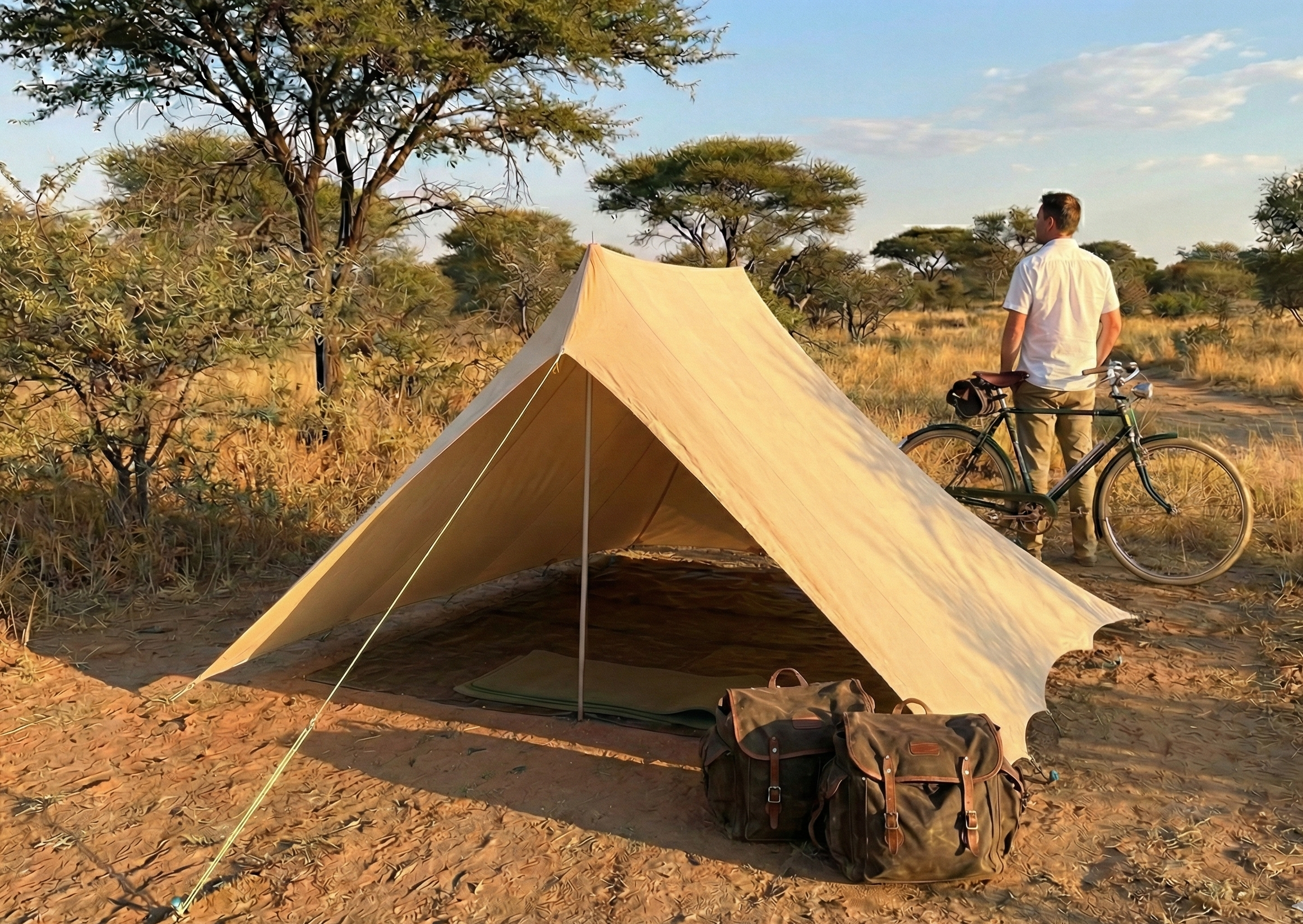
The tent was a Blacks' Good Companions, with a metal pole. I hadn't a fly-sheet, and found the tent quite satisfactory without at that time of year, but it would probably be desirable to have one during the wet season.
My stove was a pint Primus. In fact the only equipment I had which I would not carry in England were a quart size water bottle and a tin of water purification tablets. The latter I never used as I found it worthwhile to get out the stove and brew up tea at lunch-time. Before starting off each day I boiled sufficient water to fill the water bottle unless the water supply was trustworthy. Incidentally, the water from bore-holes is always safe, though it sometimes has an odd taste caused by dissolved minerals.
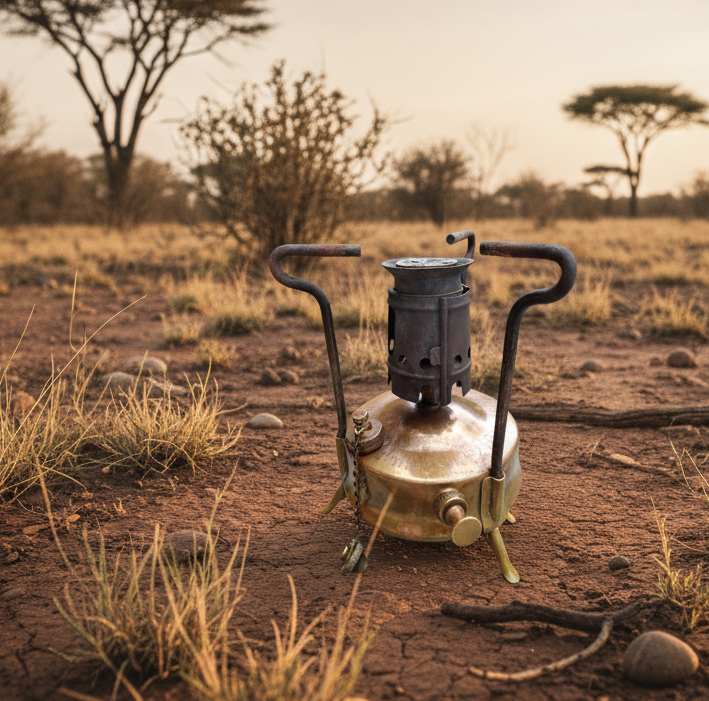
Primus 210 Stove
I kept a record of expenditure, and the average at the end of this trip was just 5/7d (about 28p) per day, which doesn't include the cost of an inner tube and a new brake cable. At one time the average was only 4/3d (about 23p), and I have no doubt that I could have kept it down to that had it been necessary for the whole trip, by doing without such luxuries as chocolate (expensive there) and lots of fruit. The train journey from Cape Town to Salisbury takes over three days, and costs a pound or so less than I spent during my two months tour. I saw infinitely more of South Africa than I would have seen from the train, even if I had travelled by day.